

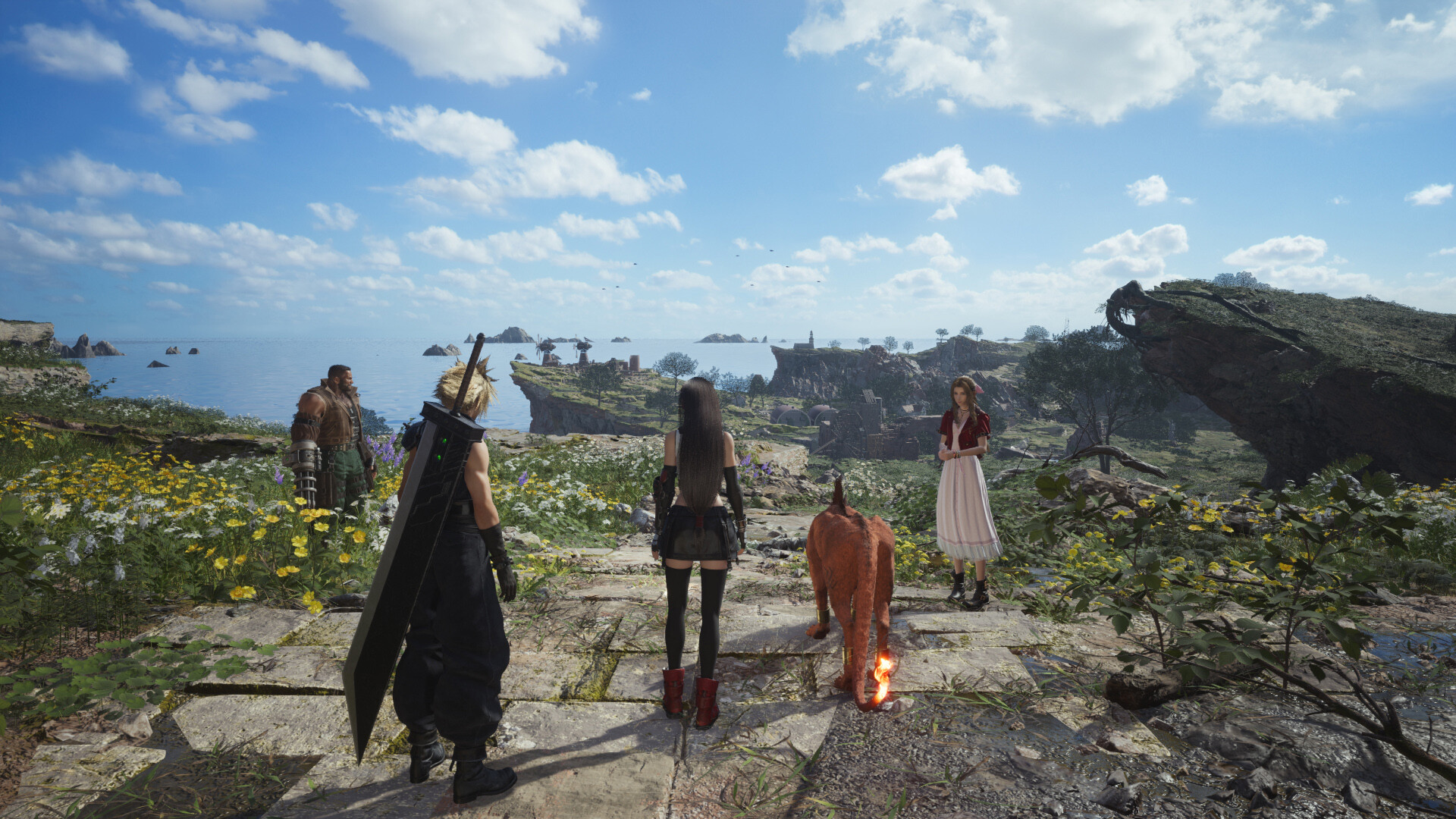
While some may believe that Final Fantasy 7 getting split up into three games for the remakes may have led to some bloat added in, director Naoki Hamaguchi has said that there wasn’t any other way that the team could have adapted the seminal 1997 RPG for a modern world. In an interview with nTower, Hamaguchi, who took on the role of project lead for the trilogy with Final Fantasy 7 Rebirth, said that the decision to make it a trilogy was made before he joined the project.
“It wasn’t so much about ‘wanting’ to make it a trilogy – the accurate assessment is that, upon objectively evaluating the sheer volume of the story and the content that needed to be depicted, no option other than a trilogy was realistic,” he explained.
Among the changes made to Final Fantasy 7 to facilitate the trilogy was to heavily expand on the earlier parts of the story for Final Fantasy 7 Remake. While the city of Midgar served as a relatively small part of the larger RPG, the 2020 remake instead turned it into a dense, massive game in its own right. This level of density and sense of scale was the team’s intention with all of the locations of Final Fantasy 7.
“The Midgar segment of Final Fantasy 7 is a relatively short part of the original game, but it is incredibly dense with information regarding the game’s world, characters, and story,” he said. “It became clear early on that if we were to faithfully recreate this using modern techniques, we would need a substantial amount of content just to make it work as a standalone title.”
Hamaguchi also discussed the work that the team had to do in order to create clear breakpoints in the story of Final Fantasy 7, where each entry of the Remake trilogy could end. One example of this is the end of Final Fantasy 7 Rebirth.
“In the original plan, the story didn’t clearly break at the forgotten capital and Aerith’s fate,” he said. “At that time, I suggested to producer [Yoshinori] Kitase-san, ‘Considering the narrative focus, wouldn’t it be better to treat Aerith’s fate as a natural break to this section?’”
Co-director Tetsuya Nomura added on to Hamaguchi’s statement by saying, “From there, the overall framework for the entire trilogy came together very smoothly.”
Just last month, Hamaguchi had also spoken about how the development team was avoiding making any large changes to the Final Fantasy 7 story, since it is “one of the aspects of development we were most sensitive about.” The few changes that were brought in, he said, were largely to better align the story’s emotional beats with the player’s own emotions and flow while playing the games.
“It wasn’t so much a matter of adding or changing the story, but rather adjusting things in a way that ensured that the player’s emotional pacing aligned with the flow of time,” Hamaguchi explained. “That process required revisiting scenes again and again, and honestly, it was one of the aspects of development we were most sensitive about.”
While no announcement has been made for a title or release date for Final Fantasy 7 Remake Part 3, the studio is currently working on bringing Final Fantasy 7 Rebirth to Nintendo Switch 2 and Xbox Series X/S on June 3rd. For more, check out our review of the Nintendo Switch 2 release of Final Fantasy 7 Remake Intergrade.
Comments are closed.