

There’s a contradiction at the heart of Avatar Legends: The Fighting Game: its hand-drawn animations are lovingly crafted, and they welcome you into the arena. It’s a simple four-button, 1v1 fighter too, where spamming light attacks unleashes flashy and effective combos. But, as for the fighting itself: it’s fast, formidable, and initially overwhelming. The game immediately asks you to step into a tornado (or a ball of fire or tidal wave depending on who you’re maining). If your reflexes aren’t already trained for such pace, your opening salvos could be a struggle.
Developer Gameplay Group International are pitching Avatar Legends – as many modern fighters do – as easy to learn yet difficult to master. This translates, of course, to being hospitable for casuals while appeasing competitive players looking for long-term commitment.
So, those auto combos you unleash by tapping light attack repeatedly will get your foot in the door; next you’ll be chaining light to medium to heavy attacks before executing quarter-circle specials, revealing the foundation on which mechanical depth is built. Quickly, Avatar Legends confirms it isn’t difficult because of complicated inputs. It’s difficult because its speed demands perfect zoning and precise timing. Its auto combos remain surface-level mechanics throughout; the combat potential that emerges leads to one of the most exhilarating fighters around.
[embedded content]
“Take Azula, for instance, whose Dragon Punch-alike light special Rending Blaze hoists her opposition upward where her prowess as an aerial specialist comes to the fore.”
And here’s another thing: the learning curve becomes inviting too, much like the game’s affable anime character designs. Auto combos are universal across the roster, as are quarter-circle inputs to perform specials and EX moves. Specials’ specific manoeuvres vary between characters, of course, with many launching opponents into the air so you can extend the chain into an airborne spectacle before your enemy has a chance to reset.
Take Azula, for instance, whose Dragon Punch-alike light special Rending Blaze hoists her opposition upward where her prowess as an aerial specialist comes to the fore. She zips through the air with ease, continuing a light to heavy chain before unleashing another special to smash her opponent into the ground. Again, the complexity here isn’t found in input strings, but in timing each attack to the millisecond.
And whilst Azula’s tools for lifting her enemies are shared near-enough across the twelve-strong roster, each character in Avatar Legends feels remarkably distinct. Toph, an earthbender, is similarly intuitive, her grounded attacks meeting success through careful spacing as much as timing, yet she’s arguably amongst the game’s most beginner friendly. Aang is another aerial specialist while Katara relies on relentless close-quarter pressure. Kyoshi, meanwhile, is a larger silhouette, her slower windups mix power with graceful animations.
Sokka inhabits a different philosophy entirely, relying on weapon mastery and deceptive mix-ups instead of elemental abilities. Through his signature boomerang projectile and Meteorite Sword, he possesses one of the most technical movesets in the game, and he’s also one of the most unpredictable opponents to face.
And Sokka, like the rest of the cast, can have his fighting style finetuned by one of three lore-specific Support Characters: Princess Yue provides him with zoning assistance, helping to cover more ground, while Master Piandou adds damage scaling to his sword strikes. Suki unlocks an unlimited Flow meter granting him extra running and dash ability.

“Quickly, Avatar Legends confirms it isn’t difficult because of complicated inputs. It’s difficult because its speed demands perfect zoning and precise timing.”
Aang’s Support Characters reshape his abilities more dramatically: Monk Gyatso buffs his signature Air Scooter and Momo augments his aerial gliding skill, while Appa gives Aang the ability to cancel every one of his standard moves into a Flow manoeuvre. Without Appa, only specific moves can be cancelled into Flow. We’ll get into Flow to explain how transformative this is in a second, but what should be clear is that the Support Characters bring meaningful diversification across what is already a diverse roster. They can be used to support your individual playstyle, or chosen on a match-by-match basis. And, impressively, despite all of these differences, the roster remains balanced.
Now, onto Flow, and it’s important to understand that this isn’t simply a movement mechanic, but a vital tool for offensive repositioning and evasion. Take Korra for instance – the hit counter on her foundational auto chain into launcher combo could not continue if you didn’t use Flow’s momentum to jump into the air to continue the string. For Aang, when supported by Appa, Flow becomes integral to skipping recovery animations, allowing you to maintain pressure by stitching together combos that otherwise would be impossible.
Each character’s Flow functions uniquely too: Sokka can swiftly close the space opened by a couple of light attacks by simultaneously knee-sliding and kicking up dirt to temporarily blind his opponent, while Kyoshi’s weighty movement is offset by a surprising level of aerial dexterity; her airborne ‘Dust Stepping’ a way to traverse the arena more swiftly than she’s capable on foot. Her Flow meter recharges faster than anyone else’s too, meaning if you want to main Kyoshi you’ll need to master her Flow mechanics.
Actually, that’s true for most of the characters. Flow is where Avatar Legends’ combat becomes the most expressive, but overuse isn’t without risk. See, depleting your Flow meter leaves you in an Unbalanced state, where Flow moves become unavailable and you become exposed to Counter Hits, Hard Knock-Downs, and Critical Throws, guaranteeing a full follow-up combo.
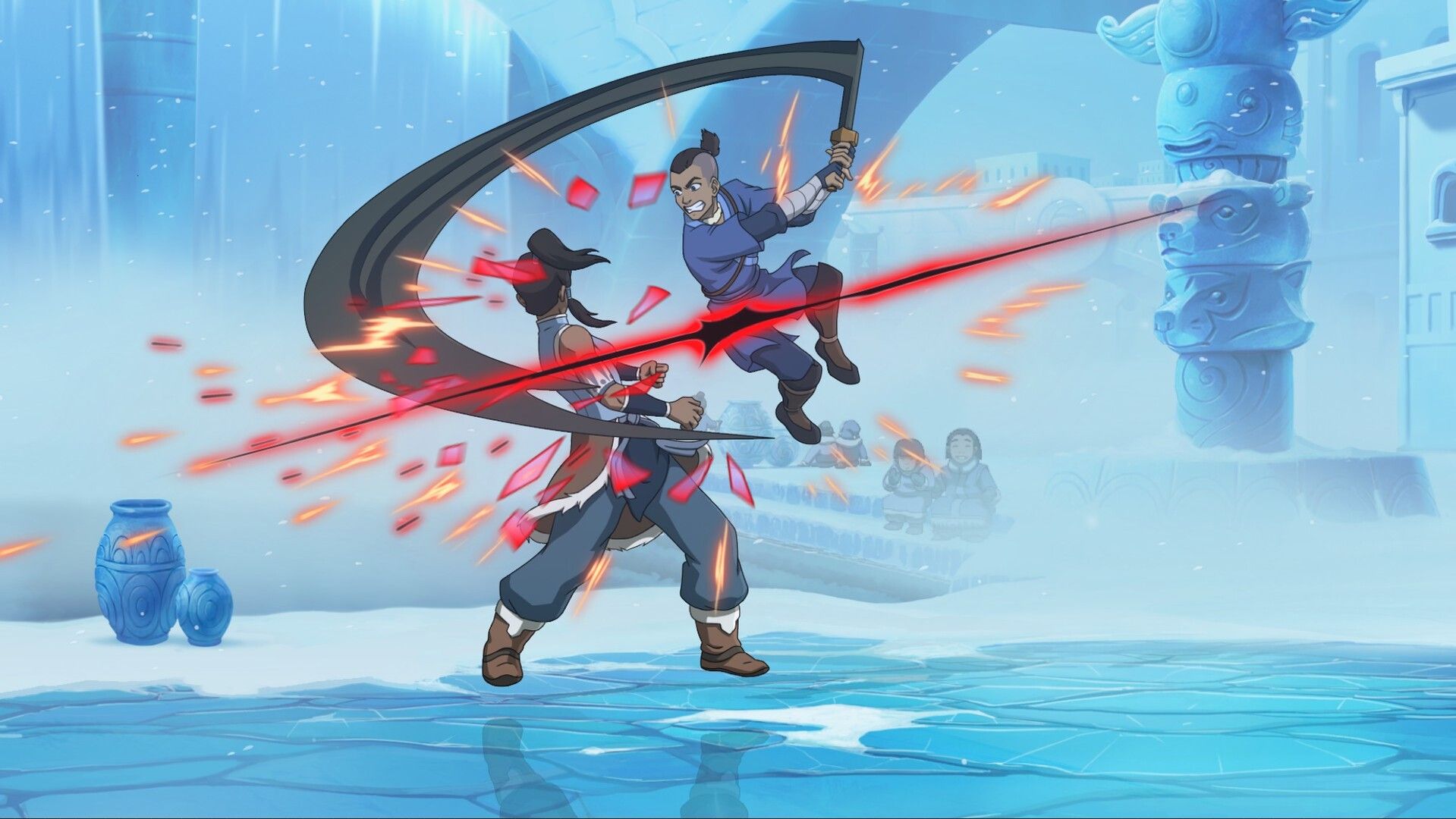
“Flow is where Avatar Legends’ combat becomes the most expressive, but overuse isn’t without risk.”
So, there’s a wildly diverse yet balanced roster, each with a suite of augmentable approaches, plus something we haven’t gotten into yet: Critical Hits. These are character-specific actions which reward you for roleplaying their personality – extra combo potential for Azula so long as you haven’t lost a round, blocking three attacks as Aang without retaliation rewards two Energy Points to be spent on Specials and EX Specials, and so on. All in all, the mechanical possibilities throughout the game aren’t just about chasing power through depth, but they’re extensions of each character’s persona given to you as tools for your own expression.
The only issue, really, is Avatar Legends’ training mode which isn’t as robust as it could be. All of the systems discussed in this review are intuitive enough, but the game’s Tutorials specifically would serve you better if they outlined the basics and the purpose of each system. As it is, they expect you to be able to execute long input strings, assuming you already have experience.
This drawback is compounded when you begin Story Mode – an episodic playthrough where fights are interspersed with cutscenes. See, Aang is the story’s starter character, but it’s debatable how approachable Aang is to beginners. If you want to get a handle on Aang’s moveset, or any other character for that matter, you can open up free practice against a modifiable ‘dummy’, or go more in-depth with Trials. Here, each combo string is explained, and a demonstration is offered followed by a button-by-button breakdown. It’s a comprehensive way to learn and practice the exhilarating extensions made possible by the auto combo chain foundation. It’d be useful if this process was replicated in the more demanding Tutorials, but as they are Trials, and the forty-hit combo Master-level Trials especially, are exciting signifiers of the game’s high skill ceiling.
Beyond the excellent combat, Avatar Legends: The Fighting Game packages together a respectable suite of modes. Alongside training and the narrative campaign are character-specific arcade ladders plus local and online multiplayer. The game feels every bit a competitively-skewed fighter, with both ranked and casual matches supported by rollback netcode and cross-platform play ensuring growing confidence can eventually be tested against human opposition.
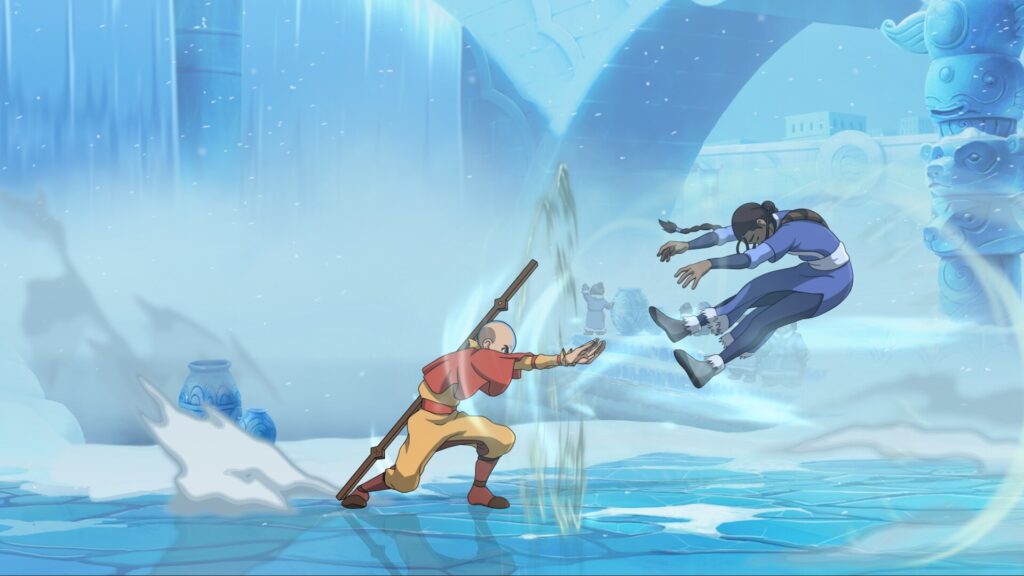
“Beyond the excellent combat, Avatar Legends: The Fighting Game packages together a respectable suite of modes.”
Overall, the surrounding package resists distracting from the fighting itself. Instead, through the comprehensive character Trials specifically, the game reinforces the idea that improvement comes through experimentation, repetition, and a gradual broadening of your relationship with each character.
This idea stretches to Story mode’s light progression systems too, where earned experience and currency can be invested in Momo’s Bazaar to strengthen Support Characters. Elsewhere, unlockable costumes and a steadily expanding Gallery provide more incentives to return.
Everything is held together by audiovisual presentation that rarely misses a beat. Punchy sound design lends a convincing impact to every strike, while an energetic soundtrack maintains the momentum, lightning-quick pace, and elemental chaos of every round. Responsive controls and swift transitions between bouts ensure there are no obstacles between you and your next round.
Fittingly, then, Avatar Legends: The Fighting Game’s greatest achievement isn’t simply about making each victory feel satisfying. It’s that improvement itself is rewarding.
Make no mistake, extensive combos are easy to drop, but the game rarely discourages you. Perhaps through its suite of awestriking basic manoeuvres, the approachability of its combo extensions, or simply the sensory impact of a pair of fighters zooming across an arena, the game consistently communicates why you should keep playing.
What initially seemed contradictory, or even intimidating, soon becomes an act of expression, and one you’ll be happy to engage with long after you’ve mastered the auto combo into launch.
This game was reviewed on PlayStation 5.
Comments are closed.